Free dilution toolUpdated

Bacteriostatic water calculator.

The water volume sets the vial's concentration, and every draw that follows. Enter the vial strength and a candidate water volume to see the concentration and resulting mark.

Dilution

Try the dilution.

Compare a candidate water volume before it changes the concentration of the whole vial.

mg
ml
mcg
Draw to
10 units

5 mg in 2 ml · 25 mcg per unit

0u10u drawn100u

On a 100 unit insulin syringe. The app remembers your setup so you never re-enter it.

The working stays in view.

Every answer remains connected to its units, formula, assumptions, and worked examples. Nothing important is hidden behind the result.

  1. 01

    Start withthe vial strength

    The total amount on the label
  2. 02

    Trya water volume

    A candidate amount in millilitres
  3. 03

    Comparethe resulting draw

    Concentration, volume, and units

What bacteriostatic water is

Bacteriostatic water is sterile water containing roughly 0.9% benzyl alcohol as a preservative. The preservative is what allows a vial to be entered more than once, because it inhibits bacterial growth in the remaining solution. Plain sterile water has no preservative and is typically treated as single-use.

Bacteriostatic waterSterile water for injection
Preservative~0.9% benzyl alcoholNone
Typical useMulti-dose vialsSingle use
Once openedCommonly labelled for up to 28 daysDiscard after use
StoragePer the manufacturer labelPer the manufacturer label

Choosing a diluent volume

There is no single correct volume. It is a trade-off, and it is set with your healthcare professional. The mechanics, though, are fixed:

  • More water gives a lower concentration and a larger draw for the same dose. Larger draws are read against more of the barrel, which typically makes small measurement errors proportionally smaller.
  • Less water gives a higher concentration and a smaller draw. That keeps injection volume down, but a dose may land within the first few units of the barrel, where a half-unit misread is a larger share of the total.
  • Vial capacity is a hard limit. A 2 mL vial cannot take 3 mL of diluent, whatever the arithmetic says.

Reverse-calculating from a target concentration

To hit a specific concentration, divide the vial strength by it. For a 10 mg vial at a target of 5 mg/mL, that is 10 ÷ 5 = 2 mL of bacteriostatic water.

Diluent volume needed to reach a target concentration.

Vial strengthTarget 2 mg/mLTarget 5 mg/mLTarget 10 mg/mL
5 mg2.5 mL1 mL0.5 mL
10 mg5 mL2 mL1 mL
15 mg7.5 mL3 mL1.5 mL
30 mg15 mL6 mL3 mL

A convenient trick: reconstituting so that the concentration in mg/mL equals the vial strength in mg divided by 1 mL makes the unit count read directly. At 1 mL of water in a 10 mg vial, 100 units is the entire vial, so 10 units is exactly 1 mg.
Common questions,clearly answered.

Open the question you need. Each answer keeps the calculation, units, and limits close to the question.

How much bacteriostatic water do I add to a peptide vial?

Mechanically, divide the vial strength in mg by the concentration you are aiming for in mg/mL. Which concentration to aim for is a decision for your healthcare professional, not a fixed number.

What is the difference between bacteriostatic and sterile water?

Bacteriostatic water contains around 0.9% benzyl alcohol as a preservative, which is what typically allows multi-dose use. Sterile water for injection has no preservative and is generally single use.

How long does a vial last after bacteriostatic water is added?

Manufacturer labelling for bacteriostatic water commonly specifies up to 28 days from first entry. The peptide itself has its own stability characteristics, which vary. Both are questions for your healthcare professional and the product labelling.

Does adding more water reduce the dose?

No. It reduces the concentration, so the same dose occupies a larger volume. The amount of peptide drawn is unchanged; only the amount of liquid carrying it changes.

Can I add too much bacteriostatic water?

The practical ceiling is the physical capacity of the vial. Beyond that, a very dilute solution means a large injection volume for each dose, which is a trade-off to discuss with your healthcare professional.

Keep the answer with the context.

Peptmate remembers the vial setup, calculates every scheduled draw, and keeps the number beside the log it belongs to.

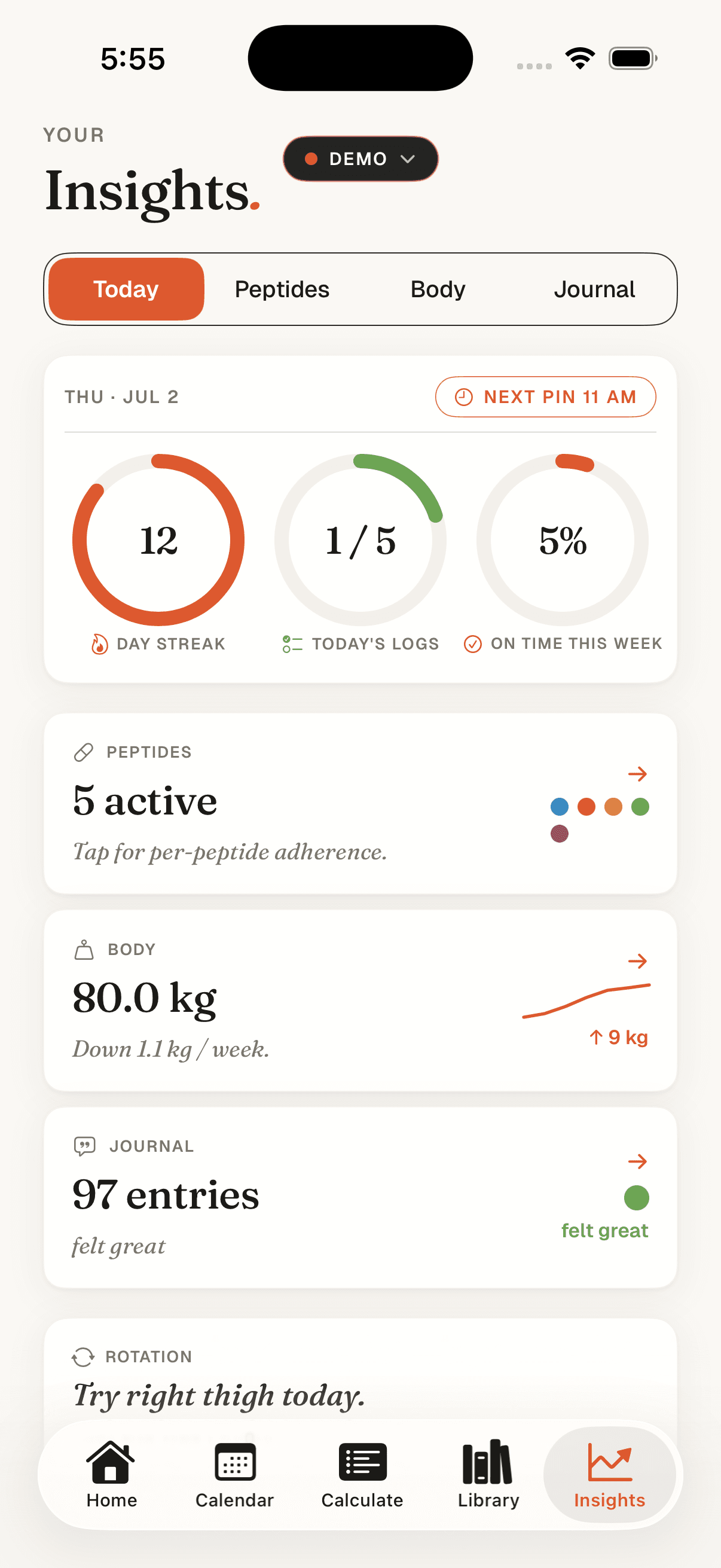
Peptmate insights screen showing protocol tracking at a glance