Free reconstitution toolUpdated

Peptide reconstitution calculator.

Enter the vial strength in mg, the bacteriostatic water in mL, and the dose in mcg. The calculator returns the exact mark to draw to on a U-100 syringe.

Reconstitution

From vial to draw.

Change any input and the concentration, volume, and syringe mark stay connected.

mg
ml
mcg
Draw to
10 units

5 mg in 2 ml · 25 mcg per unit

0u10u drawn100u

On a 100 unit insulin syringe. The app remembers your setup so you never re-enter it.

The working stays in view.

Every answer remains connected to its units, formula, assumptions, and worked examples. Nothing important is hidden behind the result.

  1. 01

    Start withthe vial label

    Strength in mg and water in mL
  2. 02

    Work outthe concentration

    How many mg sit in each mL
  3. 03

    Draw tothe syringe mark

    Volume translated into U-100 units

The formula behind the number

Reconstitution math is two steps. First you find the concentration of the reconstituted vial, then you find the volume that carries the dose. The syringe reading is a third step only because insulin syringes are marked in units rather than millilitres.

  1. Concentration (mg/mL) = vial strength in mg ÷ bacteriostatic water in mL.
  2. Volume (mL) = dose in mg ÷ concentration in mg/mL. A dose given in mcg is divided by 1,000 first.
  3. Units on a U-100 syringe = volume in mL × 100.

A worked example

A 5 mg vial reconstituted with 2 mL of bacteriostatic water, against a 250 mcg dose set by a healthcare professional:

StepCalculationResult
Concentration5 mg ÷ 2 mL2.5 mg/mL
Dose in mg250 mcg ÷ 1,0000.25 mg
Volume0.25 mg ÷ 2.5 mg/mL0.1 mL
Syringe units0.1 mL × 10010 units

So the draw is to the 10 unit mark. Change the water volume and the mark moves: the same 5 mg vial reconstituted with 1 mL instead gives 5 mg/mL, and the same 250 mcg dose lands at 5 units.

How to reconstitute a vial

  1. 1
    Read the vial's total strength

    The label shows total peptide in the vial, in mg. It is the whole vial, not one dose.

  2. 2
    Set the bacteriostatic water volume

    This volume, set with your healthcare professional, fixes concentration. More water gives a lower, easier draw.

  3. 3
    Add the bacteriostatic water slowly

    Aim the stream at the vial wall, not the powder, since peptides are fragile in solution.

  4. 4
    Let it dissolve without shaking

    Swirl gently or simply wait. Agitation is generally avoided.

  5. 5
    Calculate the draw in units

    Divide strength by water for concentration, divide dose by that, then multiply by 100 for units.

  6. 6
    Record the reconstitution for later

    Strength, water volume, and date make every later dose calculable. Peptmate stores this setup once.

Common reasons the number looks wrong

  • Dose entered in mg instead of mcg. A 250 in the mcg field is 0.25 mg. A 250 in a mg field would be a thousandfold different.
  • Vial strength read as a per-dose amount. The mg on the label is the whole vial.
  • A syringe that is not U-100. A U-40 or U-50 barrel uses a different scale, so the × 100 step does not apply.
  • Water volume estimated rather than measured. The concentration is only as accurate as the diluent volume, and every later draw inherits that error.
Common questions,clearly answered.

Open the question you need. Each answer keeps the calculation, units, and limits close to the question.

Is this peptide reconstitution calculator free?

Yes. It runs in the browser, needs no account, and nothing you enter is sent anywhere or stored.

What is the peptide reconstitution formula?

Concentration = vial mg ÷ water mL. Volume = dose mg ÷ concentration. Units on a U-100 syringe = volume mL × 100. A dose in mcg is divided by 1,000 to convert it to mg first.

How much bacteriostatic water should be added to a vial?

That is set with your healthcare professional. Mechanically, the volume is what determines the concentration: more water gives a lower concentration and a larger draw, which some people find easier to read accurately on a syringe.

Does the calculator work for any peptide?

The arithmetic is the same for anything supplied as a lyophilised powder measured in mg and reconstituted with a liquid diluent. The calculator converts numbers; it holds no assumptions about which compound they describe.

Why does my syringe read in units and not mL?

Insulin syringes are graduated for insulin. A U-100 barrel is marked at 100 units per mL, so units are just hundredths of a millilitre. See the insulin syringe unit converter.

Does Peptmate save my reconstitution setup?

The Peptmate iOS app stores the vial strength and diluent volume per vial, so the units for each logged dose are already calculated. This web calculator is a single session and stores nothing.

Keep the answer with the context.

Peptmate remembers the vial setup, calculates every scheduled draw, and keeps the number beside the log it belongs to.

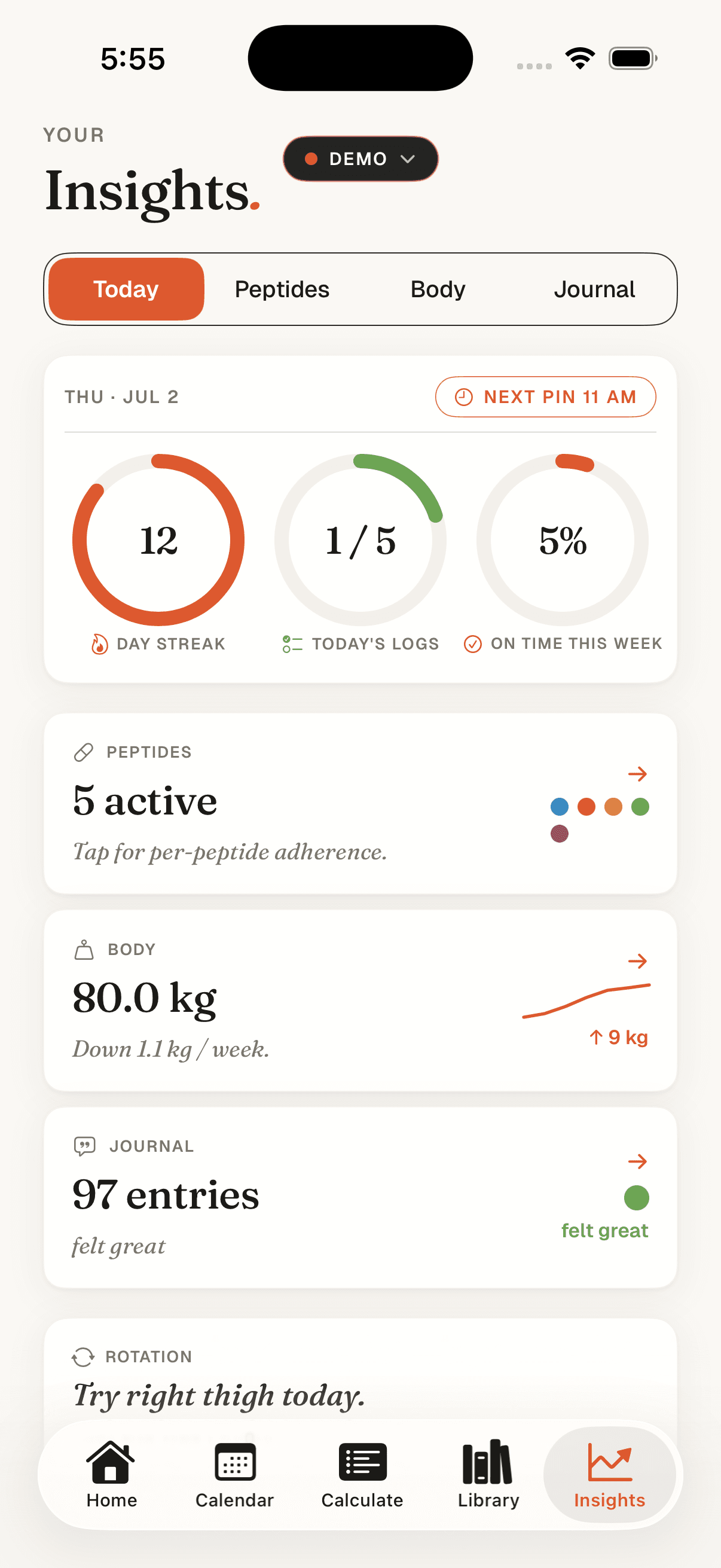
Peptmate insights screen showing protocol tracking at a glance