Free syringe conversion toolUpdated

Insulin syringe unit converter.

On a U-100 syringe, 100 units is 1 mL, so 1 unit is 0.01 mL. Converting a dose in micrograms to units needs the vial's concentration. Both conversions are below.

Syringe conversion

Read the barrel.

Units and millilitres share a fixed scale. Micrograms join the conversion only when concentration is known.

100units=1mL

1 unit = 0.01 mL

  • 5 units0.05 mL
  • 25 units0.25 mL
  • 50 units0.50 mL

The working stays in view.

Every answer remains connected to its units, formula, assumptions, and worked examples. Nothing important is hidden behind the result.

  1. 01

    Checkthe barrel scale

    Confirm that the syringe is U-100
  2. 02

    Convertunits and mL

    One unit equals 0.01 mL
  3. 03

    Add when neededthe concentration

    Required to convert micrograms

Units to millilitres

This conversion is fixed and needs nothing else. A U-100 syringe is graduated at 100 units per millilitre, so every unit is one hundredth of a millilitre, regardless of what the syringe contains.

U-100 insulin syringe: units to millilitres.

UnitsMillilitres (mL)
5 units0.05 mL
10 units0.10 mL
20 units0.20 mL
25 units0.25 mL
30 units0.30 mL
50 units0.50 mL
100 units1.00 mL

The three common barrel sizes

All three are U-100, and the scale is identical. What differs is how much of it is printed on the barrel, and therefore how finely it is graduated.

BarrelTotal capacityTypical graduationReads well for
0.3 mL30 units1 unit, often ½ unitSmall draws
0.5 mL50 units1 unitMid-range draws
1 mL100 units2 unitsLarger draws

Micrograms to units

This conversion is not fixed, because micrograms measure peptide and units measure volume. The bridge between them is the concentration of the reconstituted vial.

  1. Convert the dose to mg: mcg ÷ 1,000.
  2. Convert to volume: mg ÷ concentration in mg/mL.
  3. Convert to units: mL × 100.

Units for a range of doses, from a 5 mg vial reconstituted with 2 mL of bacteriostatic water (2.5 mg/mL).

DoseVolumeU-100 units
100 mcg0.04 mL4 units
250 mcg0.10 mL10 units
500 mcg0.20 mL20 units
750 mcg0.30 mL30 units
1,000 mcg0.40 mL40 units

That table is only valid at 2.5 mg/mL. At any other concentration every row changes, which is exactly why the reconstitution calculator asks for the vial strength and water volume rather than assuming them.
Common questions,clearly answered.

Open the question you need. Each answer keeps the calculation, units, and limits close to the question.

How many units is 1 mL on an insulin syringe?

On a U-100 syringe, 1 mL is 100 units. That makes 1 unit equal to 0.01 mL.

How many units is 0.25 mL?

25 units on a U-100 syringe.

How do I convert mcg to insulin units?

Divide the mcg by 1,000 to get mg, divide by the vial concentration in mg/mL to get millilitres, then multiply by 100. The concentration is required, because mcg cannot be converted to units without it.

Which insulin syringe size should I use?

Mechanically, a barrel where the draw sits comfortably within the printed range is easier to read accurately than one where it sits in the first couple of graduations. The choice itself is one to make with your healthcare professional.

Is a U-100 syringe the same as a 1 mL syringe?

Not necessarily. U-100 describes the scale, 100 units per mL. The barrel size describes the capacity. A 0.3 mL syringe is still U-100; it just holds 30 units.

Keep the answer with the context.

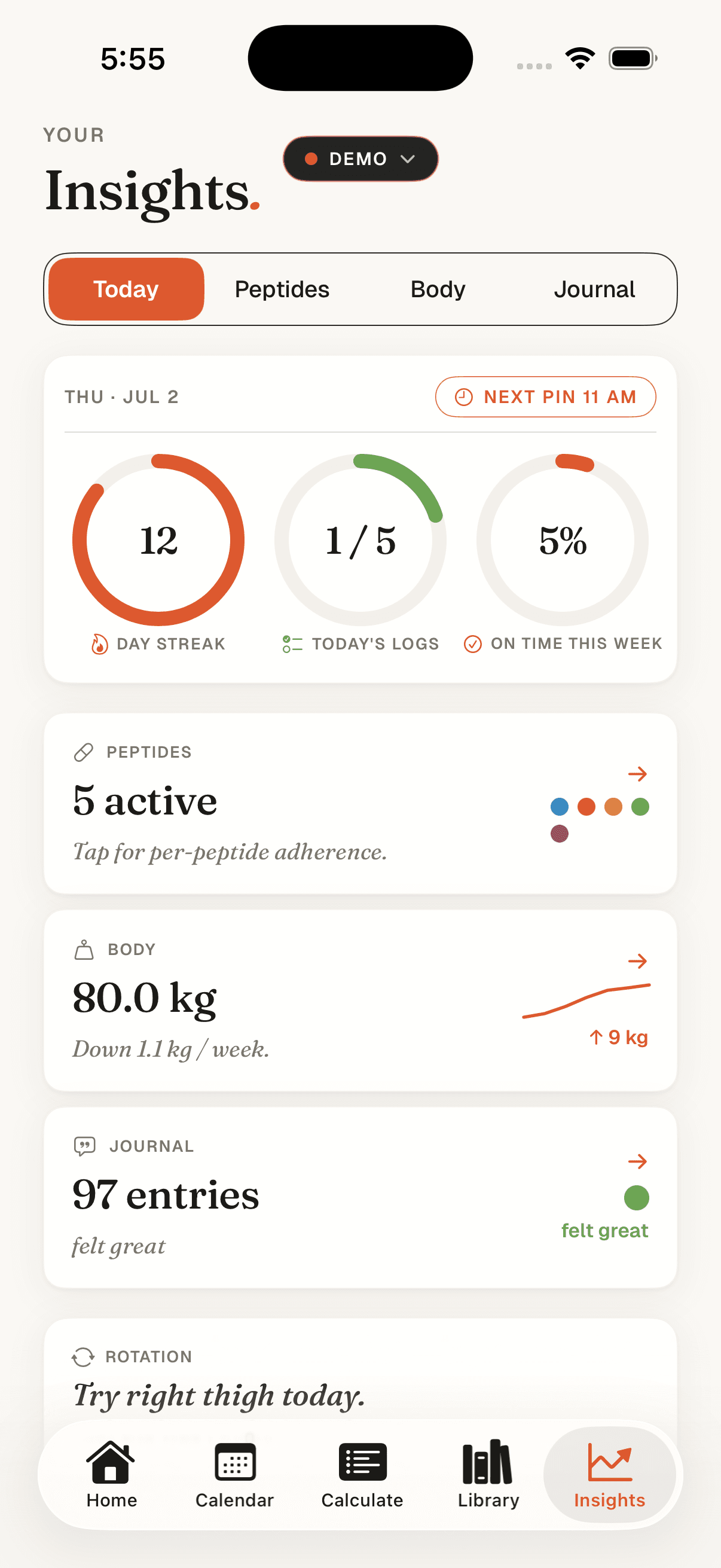
Peptmate remembers the vial setup, calculates every scheduled draw, and keeps the number beside the log it belongs to.

Peptmate insights screen showing protocol tracking at a glance